Спасибо за обращение к нам!
Мы получили ваш запрос.
В связи с большим количеством обращений, время ответа может составлять 1–2 рабочих дня.
Благодарим вас за терпение и понимание.
Спасибо за обращение к нам!
Мы получили ваш запрос.
В связи с большим количеством обращений, время ответа может составлять 1–2 рабочих дня.
Благодарим вас за терпение и понимание.
As people enter their 40s, many begin to notice that nearby text becomes blurry or that they have to hold their smartphones farther away. That’s usually the first moment they wonder, “Is this presbyopia?”Presbyopia is a natural age-related condition caused by a loss of elasticity in the eye’s lens. While younger eyes can automatically focus between near and far objects, this ability gradually diminishes over time. As a result, nearby objects such as books or phones appear blurry, and people often find themselves constantly putting on and taking off reading glasses.At this stage, many people start to wonder whether vision correction surgeries like LASIK or LASEK are still possible. In the past, there was a common belief that such procedures were not suitable once presbyopia had begun, causing some to hesitate or give up entirely on the idea of surgery. However, with advancements in technology, it’s now often possible to undergo surgery—even with presbyopia—depending on the condition of your eyes.At BGN Eye Clinic in Jamsil, patients in their 40s and 50s who are considering vision correction surgery are evaluated not just for the goal of removing glasses, but also for achieving clear vision at both near and far distances. Rather than making decisions based on age alone, we prioritize detailed diagnostic tests to determine if the eye’s structure and function are suitable for surgery.We assess various factors including corneal thickness and shape, accommodative ability, lens condition, and lifestyle patterns. Some patients, despite having presbyopia, have eyes healthy enough to undergo vision correction procedures with high satisfaction. In contrast, if early signs of cataracts or severe loss of accommodation are present, a different surgical approach may be more appropriate, highlighting the importance of accurate diagnosis.You might think, “I can just use reading glasses, right?” But many people endure the inconvenience and discomfort of readers for years. Constantly needing to carry reading glasses or switching them on and off throughout the day can lower your quality of life.If vision correction surgery can help reduce these burdens, it may very well be worth considering. Postoperative recovery and visual adaptation vary from person to person, so proper follow-up care is essential. At BGN Eye Clinic in Jamsil, we offer a structured treatment plan from pre-surgery to full recovery. After surgery, we regularly monitor vision changes and progress, and we provide eye drops or lifestyle guidance as needed.Most importantly, having presbyopia doesn’t automatically mean you must give up on vision correction surgery. While your eyes do change with age, age alone shouldn’t determine whether you’re a candidate for surgery. What truly matters is knowing the current condition of your eyes and choosing a treatment path that fits.At BGN Eye Clinic Jamsil, we provide personalized surgical solutions based on age and vision needs, aiming not just to eliminate glasses but to improve overall quality of life. Our detailed diagnostic and consultation systems are especially well-suited for middle-aged patients, offering a comfortable and reassuring experience for first-time visitors.Even if you have presbyopia, don’t assume surgery is no longer an option. With proper diagnostics, vision correction surgery may still be a valid and effective solution.If you’re curious about the condition of your eyes, come to BGN Eye Clinic Jamsil for a detailed exam and professional consultation. We’ll help you start a new chapter—one without reading glasses.
When Can I Exercise, Wear Makeup, or Go to the Sauna After Cataract Surgery?A Guide to Daily Care for Optimal Recovery After SurgeryBGN Eye Clinic Medical TeamOphthalmologist | BGN Eye Clinic JamsilQ"The surgery was quick, but when can I wash my face?"Many patients find the weeks following surgery more concerning than the procedure itself. Here is a general guide for post-cataract surgery care.Please note that exact timelines vary depending on the hospital and the specific condition of your surgery. The instructions provided by your surgeon should always be your primary reference.Table of Contents• 1. What Should I Be Most Careful About Initially?• 2. When Can I Wash My Face, Wash My Hair, and Apply Makeup?• 3. What About Exercise, Saunas, and Swimming?• 4. When to Contact Your Doctor Immediately1. What Should I Be Most Careful About Initially?The most important thing to remember immediately after cataract surgery is not to rub or press your eyes. Even if you feel a foreign body sensation, avoid touching your eye subconsciously, and ensure you consistently apply the prescribed eye drops as directed.2. When Can I Wash My Face, Wash My Hair, and Apply Makeup?CategoryRecommended TimeCare Method & DetailsWashing face & hair1 week post-surgeryWipe your face with a damp towel. Have someone else wash your hair while you lie back.Basic makeup1 week post-surgeryLight makeup around the face is allowed.Eye makeup1 month post-surgeryMakeup that directly irritates the eyes is allowed.Protective shield1 to 4 weeks post-surgeryWear constantly for the 1st week, and while sleeping for 2–4 weeks.The key is to prevent water from coming into direct contact with the operated eye.3. What About Exercise, Saunas, and Swimming?Avoid lifting heavy objects, swimming, and taking baths during the first week. It is recommended to avoid saunas, strenuous exercise that causes sweating (lasting over 30 minutes), and swimming for about 6 weeks. Pools, saunas, and Korean spas (jjimjilbangs) should also be avoided until your recovery is stable.4. When to Contact Your Doctor Immediately• Pain increasingly worsens.• Sudden drop in vision.• Redness or discomfort does not improve over several days.Vision may be blurry for the first few days post-surgery but will gradually become clear. If you are having surgery on both eyes, it typically takes about two months in total, with a gap of a few weeks between each eye, so please schedule accordingly.Always follow your medical team's instructions for your personalized recovery schedule.BGN Eye Clinic Jamsil Medical Team Comment"A successful surgical outcome depends on meticulous aftercare. Activities like washing your face and exercising are directly tied to your daily life. Although it may be frustrating, strictly adhering to the recommended timelines is the best way to protect your eye health."▶ Key Takeaways for Daily Life After Cataract Surgery• Never rub or press your eyes, and consistently apply your prescribed eye drops.• For the first week, wipe your face with a damp towel to prevent water contact. Delay swimming and sweat-inducing exercise for 6 weeks.• Contact your hospital immediately if you experience worsening pain, a sudden drop in vision, or persistent redness.References• University Journal, "Precautions after cataract surgery, lifestyle management determining recovery is important" (2026-02-04)https://dhnews.co.kr/news/view/1065582399613737• Segye Ilbo, "Newest intraocular lenses emerge... Goodbye cataracts~" (2010-07-11)https://www.segye.com/newsView/20100711001749• Kormedi, "How to cope with early-stage cataracts" (2021-06-25)https://kormedi.com/1343471/
When to Get Cataract Surgery: Should You Wait Until Your Vision is Gone?A Complete Guide from Early Symptoms to Surgical CriteriaBGN Eye Clinic Medical TeamOphthalmologists | BGN Eye Clinic JamsilQ."I heard I should wait until my cataract is fully advanced before getting surgery?"To get straight to the point: cataracts are not a condition where you must wait until your vision is completely gone before opting for surgery. However, simply being diagnosed with early-stage cataracts does not mean immediate surgery is mandatory. The ideal timing for the procedure should be determined by comprehensively evaluating the degree of lens opacity, your visual acuity, daily discomfort, and any accompanying eye diseases.Table of Contents1. Can Cataracts Be Treated with Pills or Eye Drops?2. What Are the Criteria for Determining Surgery Timing?3. What Happens If You Delay Cataract Surgery for Too Long?4. Should I Get Surgery Immediately for Early-Stage Cataracts?5. What Pre-Operative Tests Are Required?1. Can Cataracts Be Treated with Pills or Eye Drops?A cataract is a condition where the eye's natural lens, which functions like a camera lens, becomes cloudy, leading to progressively blurred vision. Typical symptoms include:• Vision that appears foggy or cloudy• Increased glare or halos around lights• Decreased night vision• Colors appearing faded or yellowish• Vision remaining blurry even after updating your glasses prescriptionCurrently, there are no proven medications or eye drops that can reverse lens opacity and make it clear again. The MSD Manual also explicitly states that there are no eye drops or medications capable of eliminating cataracts.The definitive treatment for cataracts is surgery. Generally, this involves removing the clouded lens and inserting an artificial intraocular lens (IOL) in its place. In the early stages, however, we can monitor the progression while reducing visual discomfort through updated glasses prescriptions or improved lighting environments.2. What Are the Criteria for Determining Surgery Timing?One of the most important criteria for deciding when to undergo cataract surgery is its impact on your daily life. We do not apply a universal surgical timeline to all patients based solely on a specific visual acuity score. For example, consider the following situations:• Struggling to read books or text messages even with new glasses• Experiencing severe glare from oncoming headlights during night driving• Facing difficulties at work due to a blurry computer monitor• Feeling unsafe walking due to trouble distinguishing stairs or steps• Having routine activities restricted by glare or blurred visionEven with the identical visual acuity, a professional who frequently drives at night will experience a different level of discomfort compared to someone who spends most of their time indoors. The U.S. National Eye Institute (NEI) also advises that cataract surgery should be considered when vision loss begins to interfere with everyday activities like reading, driving, or watching TV.Additionally, if a cataract prevents a clear view of the retina and the back of the eye, surgery may be recommended to diagnose and treat other underlying eye conditions. Therefore, the decision to operate should be made in consultation with your doctor, evaluating both your clinical test results and lifestyle factors.3. What Happens If You Delay Cataract Surgery for Too Long?Cataracts typically progress slowly, but if left untreated until they are overly advanced, the surgery can become far more complex, and the risk of certain complications may increase. An article published in the Segye Ilbo (July 9, 2026) featuring Dr. So-hyang Chung, an ophthalmologist at Seoul St. Mary's Hospital, highlighted the potential issues of missing the optimal treatment window. The main risks include:• Progression to a hyper-mature cataract: This occurs when the lens becomes excessively opaque and hardened.• Increased surgical difficulty: As the cataract advances, the nucleus (center) of the lens can become rock-hard. This complicates the surgical process, potentially prolonging operation time and elevating complication risks.• Risk of elevated intraocular pressure and glaucoma: If the swelling lens narrows or blocks the anterior chamber angle (the drainage pathway for fluid in the eye), it can trigger an acute angle-closure glaucoma attack.However, these issues do not occur in every cataract patient. Risks vary depending on the type of cataract, its progression rate, and individual eye anatomy. The key is neither rushing into surgery unconditionally nor delaying it as long as possible, but rather identifying the optimal surgical timing.4. Should I Get Surgery Immediately for Early-Stage Cataracts?If you are diagnosed with early-stage cataracts but experience minimal vision loss and little disruption to your daily life, you can safely monitor the condition through regular check-ups. The U.S. National Eye Institute (NEI) notes that a cataract diagnosis does not mean you must rush into surgery immediately.However, "monitoring" does not mean neglecting your eyes. Make sure to follow these three steps:• Schedule your next follow-up appointment in consultation with your doctor.• Keep track of any new difficulties in daily life, such as night driving, reading, or color distinction.• Seek medical attention if your vision becomes noticeably blurrier or if glare worsens.Particularly, if sudden vision loss is accompanied by severe eye pain, redness, headaches, or nausea, you must seek emergency ophthalmic care, as these could be signs of an acute condition like glaucoma.5. What Pre-Operative Tests Are Required?If you are considering cataract surgery, the evaluation goes far beyond just checking how much your vision has declined; a comprehensive assessment of your overall eye health is strictly necessary. Generally, the following tests are performed depending on the patient's condition:• Visual acuity and refraction tests• Assessment of the degree of lens opacity• Intraocular pressure (IOP) measurement• Corneal topography and ocular biometry (measuring eye dimensions)• Retinal and optic nerve evaluation• Specialized tests for selecting the appropriate intraocular lens (IOL)Based on these results, we determine whether the cataract is the primary cause of your vision loss and check for any coexisting eye diseases. Furthermore, you can consult with your medical team to choose the best type of artificial lens based on your occupation, lifestyle, and preferred viewing distances.While cataract surgery is generally an outpatient procedure allowing you to go home the same day, the actual time required for surgery and recovery can vary based on your eye condition and the surgical method. Post-operative care, including regular follow-ups and strict adherence to medical guidelines, is just as important as the surgery itself.Cataract Surgery: Finding the Right Time is More Important Than Just WaitingWhen it comes to cataract surgery, delaying it as much as possible isn't always best, nor is getting it immediately upon diagnosis. The decision requires looking at how much your vision has declined, what specific inconveniences you face daily, and how far the lens opacity has progressed.If your vision remains blurry even after a glasses prescription update, or if light glare has significantly worsened during night driving, do not dismiss it as simple presbyopia. We encourage you to visit an eye clinic for a comprehensive check-up. Ultimately, the optimal timing for your surgery should be determined through thorough consultation with an eye care professional based on your individual eye health and diagnostic results.▶ Key Points Summary•Limitations of Medication: Eye drops and medications cannot eliminate cataracts. The only definitive treatment is surgery (inserting an artificial lens).•Surgical Criteria: Rather than relying solely on visual acuity scores, daily life discomfort (e.g., night driving, reading, work) serves as the primary criterion.•Risks of Neglect: Delaying surgery for too long increases the likelihood of hyper-mature cataracts, surgical complications, and acute glaucoma.[References & Sources]1. MSD Manual Consumer Version, "Quick Facts: Cataract", Revised March 2025. (https://www.msdmanuals.com/ko/home/기본-정보-눈-장애/백내장/백내장)2. Segye Ilbo, Reporter Yoon Sung-yeon, "'I can suddenly read well?'... Suspect cataracts, not just presbyopia", July 9, 2026. (https://www.segye.com/newsView/20260709516744)3. National Eye Institute (NEI), Cataract Surgery. (https://www.nei.nih.gov/eye-health-information/eye-conditions-and-diseases/cataracts/cataract-surgery)4. National Eye Institute (NEI), Cataracts. (https://www.nei.nih.gov/eye-health-information/eye-conditions-and-diseases/cataracts)
A Guide to Choosing Cataract Lenses: What is the Difference Between Monofocal and Multifocal?By the Medical Team at BGN Eye ClinicOphthalmologists | BGN Eye Clinic, JamsilQ. Is a more expensive lens always better? How should you choose a cataract lens?If you are preparing for cataract surgery, you might be wondering which intraocular lens (IOL) is the right choice. Cataract lenses are categorized into monofocal, multifocal, and extended depth of focus (EDOF) lenses, each offering distinct focal distances and features.Does a higher price tag guarantee a better lens? Not necessarily. Rather than focusing on cost, it is crucial to select a cataract lens based on a comprehensive evaluation of your current eye condition, daily lifestyle, and visual expectations after surgery.In this article, we will explore the differences between monofocal and multifocal lenses, the characteristics of EDOF lenses, and key factors to consider when choosing the lens that best suits your needs.Table of Contents• 1. Types and Characteristics of Cataract Lenses• 2. What is the Difference Between Monofocal and Multifocal Lenses?• 3. Will I Be Completely Glasses-Free with a Multifocal Lens?• 4. How Do I Choose the Right Cataract Lens for Me?• 5. What to Check Before Considering Lens Price• 6. Check Your Private Health Insurance Coverage Before Surgery1. Types and Characteristics of Cataract LensesCataract surgery involves removing the clouded natural lens and replacing it with an artificial intraocular lens (IOL). Depending on how they form a focus, these lenses are mainly classified into monofocal, multifocal, and extended depth of focus (EDOF) lenses.Monofocal Lenses: Focused on a Single DistanceMonofocal lenses are designed to focus on one specific distance, typically either near or far.While you can expect clear, sharp vision at the targeted distance, you may need glasses for other distances. A key advantage of monofocal lenses is that they generally reduce the risk of visual disturbances, such as halos or glare, which can sometimes occur with multifocal lenses.Multifocal Lenses: Designed for Multiple DistancesMultifocal lenses are engineered to provide vision across multiple distances, including far, intermediate, and near.These lenses can significantly reduce your dependence on glasses after surgery. However, some patients may experience side effects such as light glare, halos, or reduced contrast sensitivity. Therefore, it is important to consider factors like how often you drive at night or how much close-up work you do.Extended Depth of Focus (EDOF) Lenses: Expanding the Focal RangeEDOF lenses are designed to expand the depth of focus, providing a more continuous range of vision. They generally focus on delivering clear vision from far to intermediate distances, with varying degrees of near vision performance depending on the specific product.Since not all EDOF lenses eliminate glare entirely or provide perfect vision at every distance, it is advisable to review the specific characteristics of each lens model.2. What is the Difference Between Monofocal and Multifocal Lenses?• Focal Range: Monofocal lenses focus on a single distance, whereas multifocal lenses focus on multiple distances.• Glasses Dependence: With monofocal lenses, glasses may be required for untargeted distances. Multifocal lenses aim to reduce the need for glasses.• Light Glare: Monofocal lenses generally carry a lower risk of visual disturbances. Multifocal lenses may cause glare or halos.• Key Considerations: For monofocal lenses, consider the likelihood of wearing glasses. For multifocal lenses, consider potential night vision discomfort and contrast sensitivity.*Note: Actual visual outcomes and the need for glasses may vary depending on individual eye conditions, lens type, and surgical results.3. Will I Be Completely Glasses-Free with a Multifocal Lens?Multifocal lenses provide vision across multiple distances, which helps reduce dependence on glasses. However, there is no absolute guarantee that you will never need glasses after surgery.Depending on your individual refractive error, overall eye health, and the specific characteristics of the lens, you may still need reading glasses for fine print or prescription glasses for night driving.Therefore, when choosing a lens, it is important to discuss not only the possibility of being glasses-free but also the realistic degree of visual improvement you can expect at the distances you use most frequently.4. How Do I Choose the Right Cataract Lens for Me?• If you frequently drive at night:Glare and halos around headlights or streetlamps can affect your driving. Discuss the glare and contrast sensitivity profiles of different lenses with your doctor to set realistic expectations for your night vision.• If you spend long hours working on a computer:Intermediate vision (the distance to a monitor) may be your priority. Be sure to inform your medical team about the typical distance to your monitor and your general workspace setup.• If you read books or use a smartphone often:Near vision should be a primary consideration. Even among multifocal or EDOF lenses, near-vision performance varies by product, so consult your doctor about the visual range required for comfortable reading and smartphone use.• If you want to reduce your reliance on glasses:Think about the specific distances where you most want to be glasses-free. Your choice will depend on whether overall independence from glasses is your main goal, or if having exceptionally sharp vision at a specific distance is more important.• If you have other eye diseases or a history of eye surgery:If you have conditions like retinal disease or glaucoma, or if you have had previous eye surgeries, you must inform your medical team. The most suitable IOL must be carefully selected based on comprehensive diagnostic test results.5. What to Check Before Considering Lens PriceThe cost of cataract lenses varies by type and brand, but the most expensive lens is not automatically the best choice for everyone.Before making a decision, you should comprehensively evaluate the progression of your cataract, the condition of your cornea, the presence of astigmatism, retinal and optic nerve health, your daily lifestyle, and your post-operative visual expectations.Because multifocal lenses require a careful balance between visual improvement, lifestyle fit, and overall visual satisfaction, it is highly recommended to make a decision only after a thorough consultation with your ophthalmologist based on precise medical evaluations.6. Check Your Private Health Insurance Coverage Before SurgeryIf you are planning cataract surgery, it is important to check both the cost of the lenses and the specific terms of your private health insurance or indemnity insurance.Insurance payouts for hospitalization related to cataract surgery are not automatically approved just because the surgery took place. Insurance companies often comprehensively review the medical necessity of the inpatient treatment, medical records, and specific policy terms.Since coverage approval can vary depending on the insurance product and individual medical circumstances, it is advisable to contact your insurance provider directly before surgery to confirm your coverage scope and claim requirements.Lens Selection: Consider Both Eye Health and LifestyleMonofocal, multifocal, and EDOF lenses each have their own advantages and points of consideration. There is no single "correct" answer that applies to everyone.Rather than basing your decision solely on the price or type of lens, it is vital to take a holistic approach that considers your current eye health, daily habits, and visual goals.If you have any questions regarding cataract surgery or choosing an intraocular lens, please consult an ophthalmologist to determine the best treatment plan based on your test results.Key Point Summary• Cataract lenses are divided into monofocal, multifocal, and EDOF lenses based on their focal range, each presenting unique pros and cons.• When selecting a lens, prioritize your lifestyle such as night driving, computer work, and smartphone usage over the price.• Even with a multifocal lens, complete independence from glasses cannot be guaranteed, making in-depth consultation with a specialist essential.References• MSD Manual Consumer Version, "Cataracts"• Daily Pharm, "J&J Surgical Vision Launches Next-Generation Multifocal IOL in Korea" (September 12, 2025)• Newsis, "Cataract Hospitalization Compensation Difficulties... What is the Supreme Court's Ruling on Indemnity Insurance Disputes?" (March 10, 2025)*Disclaimer: This content is provided for general informational purposes only and is not a substitute for professional medical diagnosis or treatment. The decision to undergo surgery and the selection of an intraocular lens must be made based on the consultation and examination results from a qualified ophthalmologist.
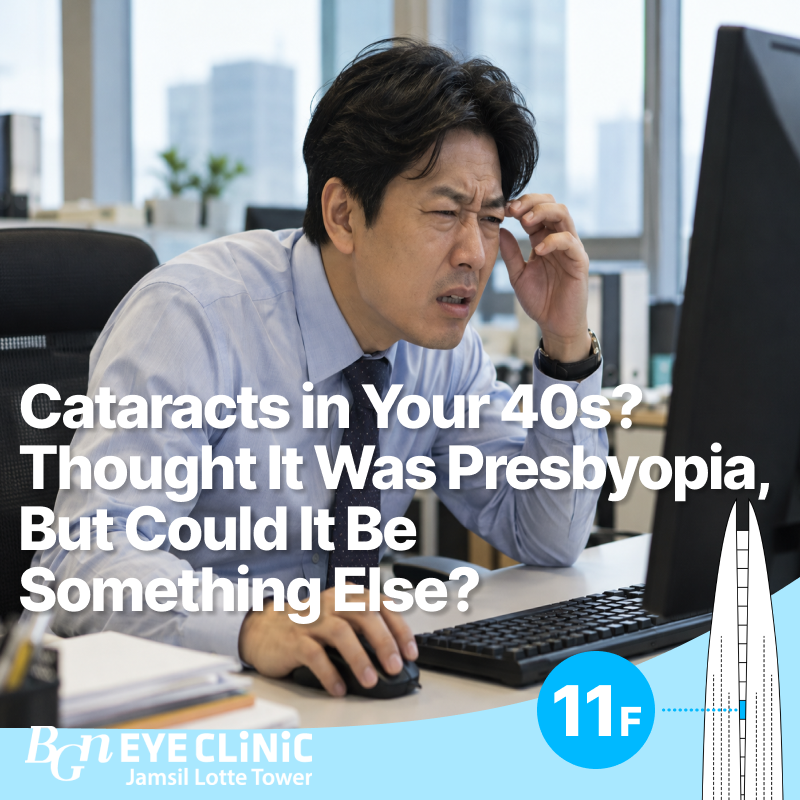
Cataracts in Your 40s? Thought It Was Presbyopia, But Could It Be Something Else?Vision Decline and Glare: Understanding the Symptoms and Causes of Cataracts in Your 40sQ: "I'm in my 40s, so it's probably just simple presbyopia, right?"When near text becomes blurry or the smartphone screen is hard to read, most people immediately think of presbyopia. But did you know these symptoms could be a sign of cataracts rather than just simple presbyopia?1. Can Cataracts Occur in Your 40s?While cataracts are predominantly known as a disease of the elderly, they can certainly occur in your 30s and 40s. Recent reports indicate a steady increase in cataract patients among younger age groups.According to data from the Health Insurance Review & Assessment Service (2025), the proportion of elderly cataract treatment costs by age was 41.9% for those in their 70s, 32.3% for the 60s, and 17.0% for the 50s. Although it mainly appears in older populations, being relatively young does not make you immune to this condition.2. Why Do Cataracts Occur at a Young Age?A cataract is a condition where the transparent lens inside the eye becomes cloudy, leading to a decline in vision. Medical experts point out several factors associated with the development of cataracts in younger people:High Myopia: Can be associated with lens changes and a higher risk of cataracts.Metabolic Syndrome: Metabolic abnormalities can affect lens health.UV Exposure: Long-term exposure to ultraviolet rays increases the risk of lens damage.Atopy and Allergies: The habit of repeatedly rubbing the eyes hard can have a negative impact.Long-term Steroid Use and Trauma: Certain medications, eye trauma, or past eye surgeries can also be linked to cataract development.Meanwhile, although there is speculation that smartphone use and blue light exposure might affect cataract development, no definitive direct causal relationship has been confirmed in large-scale human studies so far.3. How Do Presbyopia and Cataracts Differ?Presbyopia and cataracts can be easy to confuse as both may present with blurred vision. However, there are distinct differences in their causes and primary symptoms.CategoryPresbyopiaCataractsPrimary SymptomDifficulty seeing near textCloudy or blurry vision overallReading Glasses EffectImproves near visionBlurriness may remain even with glassesGlareNot a typical symptomNighttime glare or light sensitivity possibleColor PerceptionNo noticeable changesColors may appear yellowish or fadedThere is one more critical change to watch out for. What if the newspaper text, which you previously could only read with reading glasses, suddenly becomes clear?It is easy to think your vision has improved, but this could be a temporary phenomenon caused by a 'nuclear cataract', where the center of the lens hardens and changes the eye's refractive power. However, cataracts cannot be diagnosed by this change alone, and since presbyopia and cataracts can occur simultaneously, an accurate examination is necessary.4. When Should You Get an Eye Exam?You need to pay closer attention to your eye health especially if you have high myopia, a history of eye surgery, or a habit of frequently rubbing your eyes due to allergies.Wearing sunglasses with UV protection can also help reduce the risk of cataracts. Even if lens cloudiness is discovered during an exam, immediate surgery is not always required. You and your medical team can determine the treatment timing by comprehensively considering the progression of the cataract, your visual acuity, and any discomfort in your daily life.BGN Eye Clinic Jamsil Medical Team Comment:Do not dismiss vision changes starting in your 40s as simple presbyopia. If symptoms like blurry near text, glare, or light sensitivity persist, it is crucial to undergo a comprehensive exam to identify the exact cause and manage it properly.Core Summary of Cataract Symptoms in Your 40sYoung Cataracts: Cataracts can develop in your 40s due to factors like high myopia, UV exposure, and trauma.Differences from Presbyopia: Cloudy vision not improved by reading glasses, nighttime glare, and changes in color perception are signs to suspect cataracts.Sudden Vision Improvement: If near text temporarily becomes clear without reading glasses, it could be a sign of a 'nuclear cataract'.References:1. Yoon, S. (2026, July 9). "'Suddenly I can read well?'... Suspect cataracts, not simple presbyopia." Segye Ilbo.2. Kim, G. (2026, June 13). "[Weekly Health] 'Thought it was presbyopia'... Young people can't rest easy about cataracts either." Yonhap News.* This content is provided for general health information purposes. Diagnoses and treatment methods may vary depending on individual symptoms and eye conditions.
Cataract Surgery FAQs: What’s Normal and What’s Not?Post-Op Recovery and Precautions Answered by an OphthalmologistMedical Team, BGN Eye ClinicOphthalmologist | BGN Eye Clinic JamsilQ. "After surgery, white walls look bluish and my eyes are sensitive to light. Is this a side effect?"This is a natural adaptation process. The new, clear intraocular lens (IOL) allows blue light, which was previously filtered out, to enter the eye. We will guide you through the 5 most frequently asked questions regarding postoperative clarity, the need for glasses, and warning signs that require medical attention.Table of Contents• 1. Is it normal to see a bluish tint and experience glare?• 2. My vision isn't clear right away. Was the surgery a failure?• 3. Why do I still need glasses after surgery?• 4. My vision became blurry again (Posterior Capsule Opacification)• 5. I see floating specks like dust (Vitreous Floaters)• 6. When should I contact my doctor immediately?1. Is it normal to see a bluish tint and experience glare?As we age, our natural lens turns yellow, filtering out blue light. When this is replaced with a clear artificial lens during cataract surgery, the amount of light and blue light entering the eye increases.Because of this, you may experience glare or notice that objects appear pale and bluish for a while. This is simply the retina and brain adjusting to the brighter environment, and it will naturally improve over time. However, if the discomfort is severe, please inform your medical team during your follow-up visit.2. My vision isn't clear right away. Was the surgery a failure?Your vision may be somewhat blurry for the first few days following the surgery. It will gradually clear up as the swelling subsides. Additionally, the time it takes for your brain to adjust to the new visual information through the artificial lens and properly focus varies from person to person.3. Why do I still need glasses after surgery?Depending on the type of intraocular lens implanted (such as a monofocal lens), you may still need glasses (like reading glasses) for near-vision tasks such as reading, or for driving at night. This is not a defect in the lens; rather, it is because the lens has a specific focal distance designed for clear vision.4. My vision became blurry again (Posterior Capsule Opacification)Over time after the surgery, cells can grow on the thin membrane (posterior capsule) that supports the artificial lens, causing it to become cloudy again. This is known as 'posterior capsule opacification' or 'secondary cataract'.This does not require another surgery to replace the lens. Instead, a simple outpatient laser procedure can open the cloudy membrane and restore your vision. If your vision becomes blurry again after surgery, do not delay and schedule a consultation.5. I see floating specks like dust (Vitreous Floaters)These are microscopic floaters in the vitreous humor of the eye that were previously hidden by the cloudy cataract lens. Once the lens is replaced and your vision clears, they become more noticeable.While this is a natural part of aging, if you experience floating dust or bug-like specks accompanied by flashing lights (photopsia), it could be a sign of a retinal issue such as a retinal tear. In this case, you must seek medical attention without delay.Medical Team Comment, BGN Eye Clinic JamsilTemporary fluctuations in vision or glare after surgery are natural processes as the brain adapts to the new lens. However, if these symptoms are accompanied by pain or persistent vision loss, immediate ophthalmic evaluation is required.6. When should I contact my doctor immediately?If you experience severe, unbearable eye pain or a continuous decline in vision over several days, you must contact the clinic and visit immediately. Although rare, complications such as infection, bleeding, a sudden spike in intraocular pressure, or corneal swelling can occur after surgery. Early detection and proper treatment by a medical professional can effectively manage these issues. If you notice any unusual signs, do not ignore them. Be sure to consult your doctor.▶ Post-Cataract Surgery Symptoms at a Glance• Blue tint / Glare: A normal adaptation to the clear new lens; it will gradually improve.• Posterior Capsule Opacification: If vision blurs again months or years later, it can be easily treated with a laser.• Emergency Care: Visit immediately if you experience severe light flashes with floaters, persistent pain, or vision loss.[Sources and References]- MSD Manual (Consumer Version) "Cataracts"- Hanyang University Medical Center, "The Intersection of Art and Medicine: Claude Monet & Cataracts" (2015-03-02)
Recommended Cataract Surgery Clinics: Criteria for Choosing Custom Intraocular Lenses Based on Comprehensive ExamsA Guide to Choosing an Eye Clinic Tailored to Your Parents' Eye Condition and LifestyleDr. Minkyung Kim, Ophthalmologist | BGN Eye Clinic JamsilQ. What clinic and intraocular lens (IOL) should I choose for my parents' cataract surgery?When considering cataract surgery for your parents, it is crucial to select an intraocular lens suited to their eye condition and lifestyle rather than simply comparing costs. Since each lens type features a distinct focal mechanism and postoperative visual characteristics, the decision must be made carefully based on comprehensive eye exams and specialist consultations.Table of ContentsSpecific Criteria to Check When Choosing a Cataract Surgery ClinicTypes and Characteristics of Customized Intraocular LensesThe Impact of Comprehensive Exams on Customized Surgery Plans1. Specific Criteria to Check When Choosing a Cataract Surgery ClinicWhen searching for a cataract surgery clinic, rather than merely comparing surgical costs or the size of the facility, it is vital to verify how preoperative comprehensive exams and consultations are conducted. Cataracts require an assessment of the overall eye condition including the cornea, retina, and optic nerve, not just the clouding of the lens. Therefore, it is highly recommended to choose a clinic with a specialized diagnostic system that guides surgical methods and IOL selection based on precise test results.Furthermore, you should observe whether the medical staff attentively listens to and understands each patient's individual lifestyle. The ideal surgical plan may vary significantly depending on the patient's primary activities, such as reading, driving, outdoor recreation, or smartphone usage.Ultimately, it is advisable to comprehensively evaluate whether the clinic is equipped with a multidimensional precision examination system, provides clear explanations of the surgical plan based on those results, and operates an ongoing postoperative follow-up care program."Cataract surgery involves removing the clouded natural lens and inserting an intraocular lens. It is a critical process to establish a surgical plan tailored to the individual’s eye condition after thoroughly reviewing both comprehensive exam results and lifestyle patterns."2. Types and Characteristics of Customized Intraocular LensesMonofocal Lenses: Clear Vision at a Single DistanceMonofocal lenses are designed to focus clearly at either a far or near distance. Because they do not scatter light across multiple focal points, they feature minimal light halos and offer clear vision compared to multifocal lenses. However, if the vision is corrected primarily for long distances, the patient may need to wear reading glasses for near tasks such as reading or using a smartphone.Multifocal Lenses: Comfortable Vision Across Multiple DistancesMultifocal lenses divide focus across far, intermediate, and near distances, helping to reduce dependence on glasses after surgery. While they offer a high level of convenience in daily life by allowing comfortable vision at various distances, their light-splitting structure may cause nighttime glare or light halos, requiring an adaptation period.Extended Depth of Focus (EDOF) Lenses: From Far to Intermediate DistancesEDOF lenses are designed to expand the depth of focus, broadening the visual range from long to intermediate distances. Depending on the specific type of lens, characteristics such as glare or halos may vary, and the degree of near-vision clarity differs. Therefore, the individual’s eye condition and lifestyle must be carefully considered.Which lens is right for me?An intraocular lens is not universally better simply because it is more expensive or has more focal points. Generally, if you frequently engage in near-vision tasks like reading or smartphone use, a multifocal lens is recommended. If you do a lot of night driving or outdoor activities where distance vision is crucial, a monofocal or EDOF lens is typically the better choice.However, rather than making a definitive choice based solely on lifestyle patterns, the final lens should be selected after an in-depth consultation with the medical staff, taking into account the health of the cornea and retina confirmed through comprehensive eye exams.3. The Impact of Comprehensive Exams on Customized Surgery PlansComprehensive exams prior to cataract surgery are not merely a process to confirm whether surgery is possible. They are essential for evaluating the overall condition of the eye including the cornea, retina, and optic nerve and for gathering the necessary data to determine the optimal surgical method and intraocular lens.Especially when considering multifocal or EDOF lenses, it is crucial to review both the condition of the eyes and the patient's lifestyle patterns together.Accurately assessing the degree of astigmatism, corneal endothelial cell count, and the health of the retina and optic nerve through comprehensive preoperative diagnostics, and reflecting these in the surgical plan and IOL selection is vital. Additionally, it is important to monitor the eye’s condition and recovery process through regular postoperative check-ups.▶ Core Points SummaryWhen selecting a cataract surgery clinic, the top priority should be whether they have a comprehensive examination and customized consultation system in place, rather than focusing solely on costs or lens prices.An expensive multifocal lens is not necessarily the right answer for everyone. The safest approach is to choose the intraocular lens that best fits the individual’s occupation, hobbies, lifestyle patterns, and eye condition.[References & Sources]• National Eye Institute (NEI), Cataract Surgery Information• American Academy of Ophthalmology (AAO), Intraocular Lens (IOL) Options for Cataract Surgery26 Years of Expertise in Precision Vision Correction, BGN Eye Clinic JamsilLocated on the 11th floor of Lotte World Tower in Jamsil, BGN Eye Clinic features a team of 8 specialists, including Chief Director Dr. Sekwang Park. In a comfortable environment overlooking Seokchon Lake, we provide over 60 advanced comprehensive exams and customized SMILE LASIK and cataract surgeries. Through our dedicated care system, we ensure precise and meticulous treatment from start to finish.● Consultation Question Checklist to Review with Your ParentsIs cataract surgery currently necessary?What specific tests will be conducted before the surgery?What are the differences between monofocal, multifocal, and EDOF lenses?Which lens is best suited to my parents' lifestyle patterns?To what extent might glasses be needed after the surgery?How will regular check-ups and postoperative care be managed?
Rising Incidence of Early-Onset Cataracts in Adults Under 60 | BGN Eye Clinic JamsilCataracts are a widely recognized ocular condition. While commonly perceived as a disease affecting adults aged 60 and older, the number of younger patients receiving an early diagnosis has been increasing rapidly in recent years. Because cataracts rarely cause pain, they often lead to gradual vision loss over an extended period without the individual noticing. As a result, many cases progress significantly before noticeable symptoms prompt patients to seek medical care.Several overlapping factors contribute to the rising prevalence of cataracts among individuals under 60. Chief among these causes behind the increasing incidence in middle-aged adults is excessive smartphone usage. In fact, the sharp rise in patients seeking diagnosis and treatment for presbyopia and cataracts closely coincides with the widespread adoption of smartphones.Smartphone Usage and Ocular AgingProlonged exposure to blue light and color wavelengths emitted by smartphone screens accelerates eye aging compared to the past. In particular, using a smartphone in a pitch-black room before going to sleep is a habit that drastically heightens the risk of early presbyopia and cataracts. Continuous exposure to color light waves under such conditions imposes substantial strain on the iris and the crystalline lens.When looking at the eye, the dark central area is the iris. In low-light environments, the iris dilates to maximize light intake, whereas in bright settings, it constricts as less light is needed. However, exposing the eyes to intense light in a dark environment causes a sudden surge in lens fatigue, significantly contributing to dry eye syndrome as well as degenerative ocular disorders.Cataract Treatment Approaches: Conservative vs. Surgical ManagementTreatment for cataracts, whether caused by aging or external factors, is broadly categorized into two main approaches:• Conservative Medical Management: This approach involves using prescribed eye drops to slow the progression of the disease after evaluating the severity of the cataract and its impact on vision. This conservative method is only applicable when the condition is diagnosed in its very early stages.• Surgical Management: If early diagnosis is missed and the condition progresses to the point of impairing vision, surgical intervention becomes necessary. The surgery involves removing the clouded natural lens and replacing it with an artificial intraocular lens (IOL). Selecting the appropriate IOL is critical, as it offers the opportunity to simultaneously correct other co-existing visual impairments, such as presbyopia and astigmatism.Early Diagnosis and Precise Treatment Are Key"To recommend the optimal surgical approach tailored to each patient, thorough pre-operative examinations are essential regardless of how experienced an ophthalmologist may be," stated Dr. Se-Kwang Park, Chief Medical Officer at BGN Eye Clinic Jamsil Lotte Tower. "Based on comprehensive diagnostic data and medical expertise, our role is to provide clear direction so that patients can make fully informed decisions for their eye health."Dr. Park added, "Because early detection determines whether conservative management is possible or surgery is required, anyone experiencing unusual ocular discomfort should make it a habit to undergo a thorough eye examination. The diagnostic process is quick, so visiting a clinic equipped for precision testing is highly recommended.""Protect your vision through early detection. Comprehensive eye examinations are the first step toward lifelong visual clarity."
Jamsil Cataract Surgery | The Core Principle Trusted for 26 YearsUnwavering Patient Care from Initial Consultation to Full RecoveryDr. Yeon-Ho LeeOphthalmologist | BGN Eye Clinic Jamsil Lotte TowerQ"I was diagnosed with cataracts at another clinic, but I wanted to get a second opinion here."Nothing is more rewarding than hearing patients say, "I am so glad I came directly to Jamsil Eye Clinic without going anywhere else."Many clinics perform cataract surgery and boast state-of-the-art equipment. However, few places dedicate themselves sincerely to the entire patient journey, from the initial greeting and rigorous analysis of diagnostic data to the final post-operative follow-up until complete recovery. We hope this article addresses all your concerns with full transparency and care.Table of ContentsWhy Patient Recommendations Have Continued for 26 YearsSuccessful Cataract Surgery Begins with Precise DiagnosticsAre Premium Intraocular Lenses Always the Best Choice?Surgeon Expertise and Post-Operative Care ProtocolsPre-Visit Checklist & Frequently Asked Questions (FAQ)1. Why Patient Recommendations Have Continued for 26 YearsThe reason for our long-standing word-of-mouth reputation is straightforward: we guide our patients completely through every phase, from comprehensive pre-operative diagnostics to returning to daily routines post-surgery, without neglecting a single detail.Since opening in 2000, BGN Eye Clinic has never compromised on the following core principles throughout our 26-year history:• Conducting a thorough, precise evaluation of the patient's current ocular health is the top priority before deciding on cataract surgery.• Recommending intraocular lenses tailored to the patient's ocular parameters and lifestyle is always superior to pushing expensive lenses.• Our responsibility as eye care specialists does not end when the surgical procedure is over.Genuine patient referrals are never built on exaggerated marketing. They are priceless assets earned through consistent, highly satisfying experiences shared by each patient.2. Successful Cataract Surgery Begins with Precise DiagnosticsMore than half of a successful cataract surgery outcome is determined in the diagnostic room rather than the operating theater. Comprehensive testing is required to calculate the exact power of the intraocular lens to be implanted.Even a minute error in diagnostic data can lead to incorrect lens power calculations, directly hindering visual satisfaction after surgery. Regardless of advanced lens technology or surgical skill, inaccurate baseline testing cannot deliver optimal visual results.[Essential Diagnostic Examinations Before Cataract Surgery]• Axial Length Measurement (IOL Master): Measures the length of the eye from front to back to select accurate lens power. Even minor errors directly affect post-operative visual quality.• Corneal Thickness & Curvature Analysis: Evaluates the shape and thickness of the cornea to determine the most suitable lens design.• Retinal & Optic Nerve Examination: Essential because implanting multifocal lenses in eyes with underlying retinal conditions can decrease visual clarity.• Intraocular Pressure (IOP) Test: Checks for coexisting glaucoma to establish correct lens selection and post-operative management strategies.• Tear Film Evaluation: Severe dry eye syndrome can reduce overall visual satisfaction following multifocal lens implantation.• Slit-Lamp Biomicroscopy: Examines the progression of lens opacity to determine the optimal timing for surgery.3. Are Premium Intraocular Lenses Always the Best Choice?This is a common point of confusion. Higher-cost multifocal lenses are not unconditionally better than monofocal options. Selecting a lens that aligns with your ocular health, profession, night driving frequency, and personal hobbies is far more critical.• Monofocal Intraocular Lenses: Covered by national health insurance, providing a cost-effective solution. They offer stable, clear distance vision, making them ideal for frequent night drivers or patients with concurrent conditions like glaucoma or retinal disease.• Extended Depth of Focus (EDOF) Lenses: Premium non-reimbursed lenses that provide smooth continuous vision from distance to intermediate ranges while significantly reducing halo and glare compared to traditional multifocal designs.• Multifocal Intraocular Lenses: Cover near, intermediate, and far distances, drastically reducing dependency on reading glasses. However, satisfaction may drop if underlying retinal or optic nerve conditions exist.Selecting the Right Eye ClinicRather than choosing a clinic that unconditionally promotes expensive non-reimbursed lenses, select one that offers honest recommendations based on objective clinical data.4. Surgeon Expertise and Post-Operative Care ProtocolsCataract surgery requires making a micro-incision of approximately 2–3 mm to gently extract the clouded natural lens and position a new intraocular lens securely inside the eye.In complex cases, surgical experience and clinical skill determine the ultimate outcome. Having completed a sub-specialty in glaucoma during my Master's degree in Ophthalmology at Yeungnam University Graduate School of Medicine, I perform precise procedures even for complex cases involving multiple eye conditions.Furthermore, post-operative care, from the moment surgery completes until vision fully stabilizes, directly dictates overall visual quality.• Dedicated follow-up examinations are conducted directly by the operating surgeon the day after surgery, at 1 week, and at 1 month to monitor corneal and ocular healing.• Precise instructions regarding eye drop administration schedules, sequences, and precautions are provided in detail.• A direct hotline is maintained for immediate communication should unexpected discomfort arise during recovery.5. Pre-Visit Checklist & Frequently Asked Questions (FAQ)[Pre-Visit Checklist for Cataract Surgery]• Comprehensive Diagnostic System: Does the clinic conduct multi-angle testing including axial length, corneal curvature, retina, IOP, and tear film?• Surgeon's Specialty: Is the operating surgeon highly experienced in presbyopia and cataract surgery, particularly with complex cases?• Customized Lens Selection: Does the clinic offer objective lens options tailored to individual ocular profiles and lifestyle patterns?• Post-Care Support: Is there a structured follow-up care protocol and emergency response system in place?[Frequently Asked Questions (FAQ)]Q: Does vision improve immediately after cataract surgery?A: While patients often notice clearer visual clarity on the day of surgery, full corneal and incisional healing takes time. Vision typically reaches optimal stability within 1 to 4 weeks.Q: Are multifocal intraocular lenses always the best choice?A: Not necessarily. For patients with underlying retinal issues, optic nerve damage, or severe dry eye, multifocal lenses may yield lower satisfaction. Choosing a lens that ensures safety and clarity based on thorough testing is essential.Q: When can I resume normal daily activities after surgery?A: Light face washing, showering, and office work are generally permitted the day after surgery following your post-operative checkup. However, avoid public baths or saunas for a month, and refrain from strenuous exercise for at least 2 weeks.Q: Can cataracts recur years after surgery?A: Once the clouded natural lens is removed, cataracts cannot recur. However, secondary cataracts (posterior capsule opacification) can develop over time, which can easily be corrected via a quick, non-invasive laser procedure.Over the past 26 years, BGN Eye Clinic has maintained one simple core philosophy: prioritizing overall ocular health and patient quality of life over surgical volume.Our greatest reward continues to be the smiling faces of returning patients who share, "Doctor, I can read clearly again and see my grandchildren's faces so vividly." We remain committed to providing honest diagnostic assessments and recommending the safest solutions tailored to your eyes.BGN Eye Clinic Jamsil: 26 Years of Precision Vision CorrectionLocated on the 11th floor of Lotte World Tower in Jamsil, BGN Eye Clinic features experienced ophthalmology specialists providing over 60 advanced diagnostic tests, customized vision correction, and cataract surgeries. Our structured, dedicated care system ensures a comfortable, secure treatment experience from start to finish.